
I got my BMW i5 M60 about six or seven months ago. Since then: 14,289 kilometres and 971 trips. Having a charger at home has made ownership easier. It has also left the economist in me wondering how much of that driving I would have done with petrol.
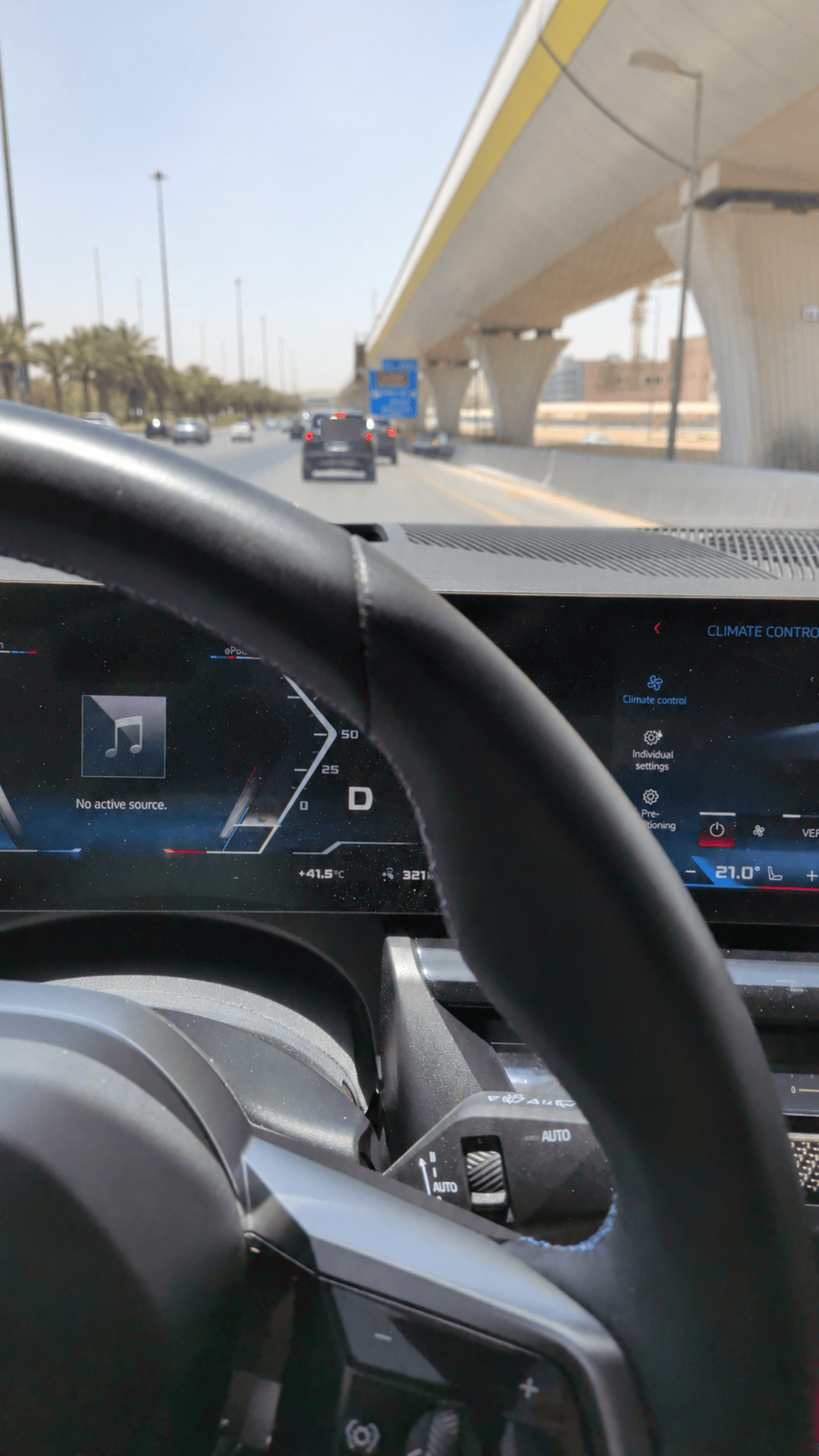

Riyadh by day. A charging stop by night.
I have noticed more options from EVIQ, Efill and other providers. A useful network reduces the detour, the planning and the time spent arranging a charge. Home charging does much of the work for me; public chargers give me flexibility. Both affect the real cost of getting around.
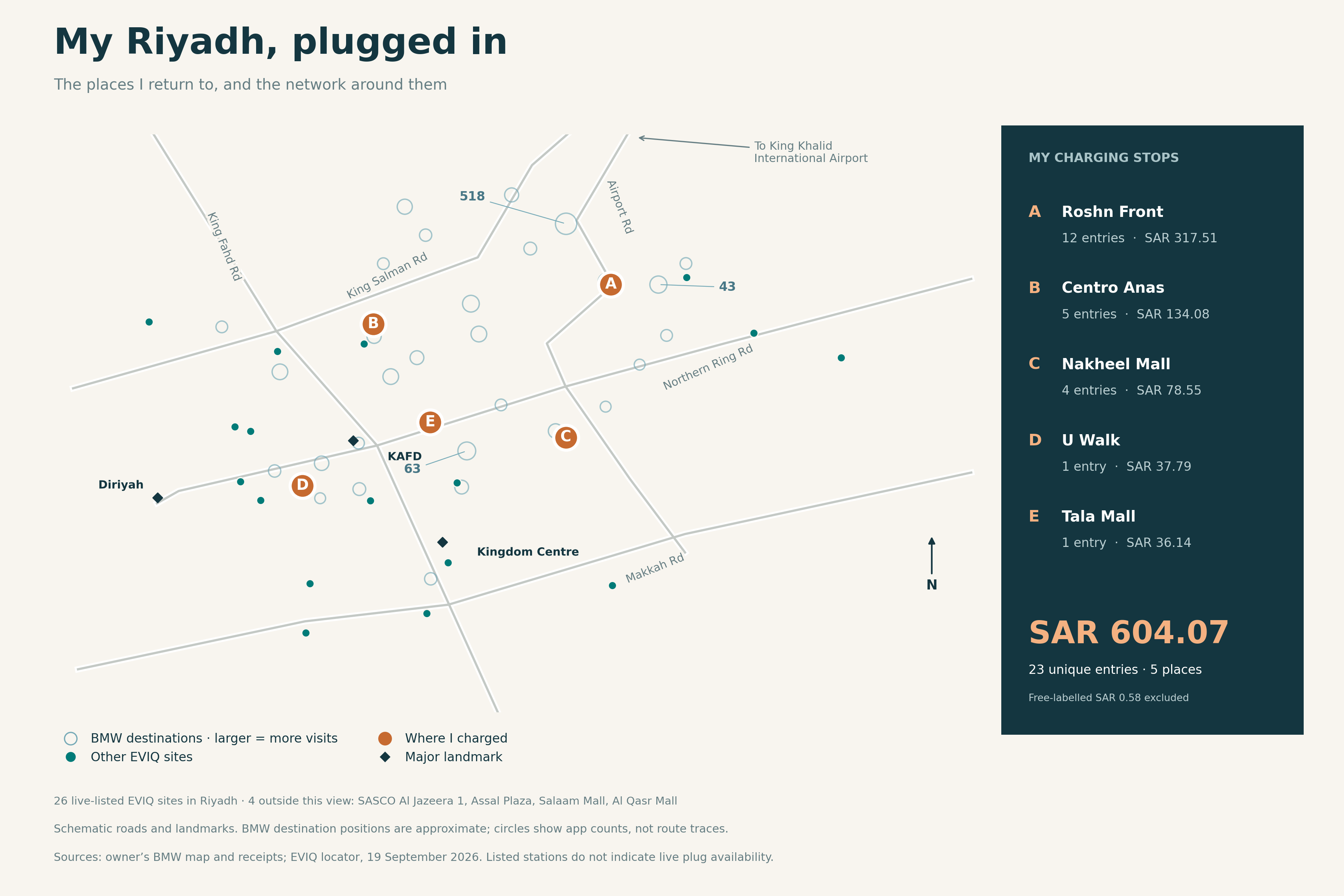
My charging history has a geography of its own: ROSHN Front, Centro Anas, Nakheel Mall, U Walk and Tala Mall. ROSHN Front appears twelve times. Across the five locations, my recorded public charging came to SAR 604.07. These are places in my routine, which is precisely why their chargers matter.
EVIQ current station map | Explore chargers in Google Maps
Adding an estimated SAR 604 for home electricity puts my total energy bill at roughly SAR 1,208. The same distance in a BMW M550i, a 4.4-litre V8 with similar acceleration, works out at about SAR 3,512 in Gasoline 95. That leaves an estimated SAR 2,304 in my pocket.

That is about SAR 8.46 per hundred kilometres against SAR 24.58: roughly 66% less on energy. If the same pattern continued to 100,000 kilometres, the saving would reach about SAR 16,100. Purchase price, depreciation and tyres still have their say in the ownership bill.
The interesting part is what happens to the saving. I suspect I would have driven less with petrol. When an extra outing costs less, more outings become worth making. Economists call this the rebound effect: some of the benefit becomes money saved, and some becomes additional travel.
But a petrol kilometre costing nearly three times as much does not mean I drive three times as far. My time still has value. Riyadh traffic has not become any more inviting. The odometer records the trips I took; it cannot tell me which ones I would have skipped.
What I can say is that charging at home, with more options around the city, has made the car easier to live with. The lower cost of another trip is part of that pleasure. It may also explain a few of those 14,289 kilometres.
Calculation notes: public receipts deduplicated, promotions included, SAR 0.58 labelled “Free” excluded. Home energy assumed at 80% of 3,648 kWh, priced at SAR 0.207/kWh including VAT; this is an energy-share assumption, not a measured split or a share of charging time. Combined cost remains an estimate. Petrol assumption: 10.55 L/100 km at SAR 2.33/L. M550i is a previous-generation performance comparison, not an identical petrol model. Projections extend the observed public spend per km, including promotions. BMW driving average: 20.3 kWh/100 km; total charged energy is used for the cost calculation.
Leave a Reply